Showing posts with label Book Review. Show all posts

Thursday, August 26, 2010

Review - The Classics: All You Need to Know, from Zeus's Throne to the Fall of Rome by Caroline Taggart


TITLE:    The Classics:  All You Need to Know, from Zeus's Throne to the Fall of Rome

AUTHOR/EDITOR:    Caroline Taggart

INFO:    Hardback, Reference, 169 pages

PUBLISHED:   Readers Digest, 2010

ISBN#:   978-1-60652-132-8
HOW'D I GET IT:   Received from FSB Media for review


FROM GOODREADS:  The thought of ancient civilizations is enough to make anyone groan. Between long hours of tedious mathematics and years of droning Latin classes, it's no wonder that the Greek and Roman societies are most often thought of as dull subjects from school. The Classics, however, flips this long-standing opinion on its head, revealing the clever humor and impressive technological and scientific advancements made by these societies. Between the ninth century B.C. and the seventh century A.D., these great civilizations thrived, leaving behind a legacy felt in every part of the world-from language to medicine, from art to architecture.   


The Classics lets you understand the importance of...


  • The Greek alphabet, from alpha to omega

  • The history and characteristics that define Greek and Roman architecture and its influence on modern building

  • Greek and Latin words, which make up more than 30 percent of the words in the English language, and how you can build your vocabulary by learning the roots 

  • The Greek and Roman gods, the mythology surrounding them, and the part these figures play in our culture

  • Almost 1,000 years of Greek and Roman history, from the birth of democracy to Caesar's empire

  • The philosophies taught by Socrates, Plato, and Aristotle and what their ideas have contributed to the world we live in today

  • How the modern cultural staples such as the Olympics were formed by classical literature, written by authors such as Homer and Cicero-what happened, what does it mean, and why is it still being read and taught today

  • And much more!


This concise and witty text makes both a fascinating introduction to the world that became the foundation for Western Civilization and the perfect refresher course for the individual looking to brush up on years of schooling. The Classics puts the same information available in volumes of stuffy textbooks at your fingertips in one entertaining read, guaranteed to inform and delight.


MY TAKE:   I got a kick out of this sometimes irreverent book.  Ms. Taggart takes what can sometimes be a very, very dry subject and injects quite a bit of wit and humor into it.  She touches on things such as the roots of words in language, the greats such as Homer and Aristotle, and then pokes a bit of fun at their logic and rhetoric.  It makes for a relatively easy read and a quick source of reference.  Very informative and interesting book.
   
MY RATING:    3/5


WHERE TO BUY IT:    Amazon.com


Image and video hosting by TinyPic


Source: http://onebookshy.blogspot.com/2010/08/review-classics-all-you-need-to-know.html

»»  read more

Friday, August 20, 2010

REVIEW: The Stormcaller, by Tom Lloyd


The Stormcaller, by Tom Lloyd
Paperback: 449 pages
Publisher: Pyr, ©2008
ISBN: 978-1-59102-693-8
Copy: Out of pocket
Reviewer: PeterWilliam


From the back of the book: In a land ruled by prophecy and the whims of Gods, a young man finds himself at the heart of a war he barely understands, wielding powers he may never be able to control.


Isak is a white-eye, born bigger, more charismatic, and more powerful than normal men...but with that power comes an unpredictable temper and an inner rage he cannot always hide. Brought up as a wagon-brat, feared and despised by those around him, he dreams of a place in the army and a chance to live his own life. But when the call comes, it isn't to be a soldier, for the Gods have other plans for the intemperate teenager: Isak has been chosen as heir-elect to the brooding Lord Bahl, the white-eye Lord of the Farlan.


The white-eyes were created by the Gods to bring order out of chaos, for their magnetic charm and formidable strength make them natural leaders of men. Lord Bahl is typical of the breed: he inspires and oppresses those around him in equal measure. He can be brusque and impatient, a difficult mentor for a boy every bit as volatile as he is.


But now is the time for revenge, and for the forging of empires. With mounting envy and malice, the men who would themselves be kings watch Isak, chosen by Gods as flawed as the humans who serve them, as he is shaped and molded to fulfill the prophecies that circle him like scavenger birds. Divine fury and mortal strife are about to spill over and paint the world with blood.


The Stormcaller is the first book in a powerful new series that combines inspired world building, epoch-shattering battles, and high emotion to dazzling effect.


Well, that's more than a mere blurb, but it does pretty much cover the main plot points. And a fine plot it is. While the info dump/assimilation quotient goes above average here, there is a Dramatis Personae at the end of the book for the reader to untangle all of the various personages walking through the storyline, as though it were a subway station. The faction tracking portion of keeping the plot straight was a bit difficult due the double-edged sword of: 1) info dump and, 2) lack of information on things that will probably be revealed in later installments. Other than the aforementioned potential snags, the plot of the story is engaging. The story elements of the setting (or world-building, whatever) have a nice mix of the imaginative and the "tried and true."


The characters really work for this tale. One could conceivably describe the characters as Eddings-esque (as a categorization and/or a possible criticism), but it would be more fair to describe them as being withheld from unnecessary over-complication and, yet, still vibrant. Each character carries a key emotive role, for the reader, and it worked in this instance.


The tale is third-person in nature, even during several key dreamscape sequences. One gets the sense that the author was attempting to veer away from the third-person during the dreamscape sequences, but didn't completely commit to doing so.


Overall, a very fun read and debut. One which shapes and stores an expectation for the next book in the series.


Characters - 8
Plot - 9
Style - 7


Overall: 8/10

Source: http://speculativebookreview.blogspot.com/2010/08/review-stormcaller-by-tom-lloyd.html

»»  read more

Tuesday, August 17, 2010

Scott Pilgrim Vs. The World - video game review


So I just sunk about 3 hours into playing all the way through the new Scott Pilgrim game and I can only say that it was time well spent. The game plays much like an old school beat-em-up such as Streets of Rage. There is however a level system and based on your level you acquire certain moves you use to fight. Along with that you earn money and with the money you go into shops to buy items to raise your other skills such as strength, defense, and speed.


The games art is done by Paul Robertson, known for his work with the Drawn to Life games and his film Pirate Baby's Cabana Battle Street Fight 2006. His art tends to be on the chibi side with all his characters looking like little pixelated people. The music is all done in midi format so it sounds like a retro game. The music in the game was composed by Anamanaguchi which is a chiptune punk band. Everything about the games art and music style lends it back to retro games and it fits perfectly with the comic.


The game has 4 playable characters and you can play up to 4 player similar to a Castle Crashers type play. The game is filled to the brim with charm from the comic and I have never seen a licensed game live up to my expectations. It isn't too say my expectations are low, most licensed games just aren't very good. It just goes to show what a good art style, music choice, and source material can do for a game. As I said earlier the game is a beat-em-up. You go through each level based on an evil ex, fighting henchman and collecting cash to power up. At the end of each level you face off against an ex. These fights are great and the animations on them are stunning. I replayed most of them just to see them again.


There are online leaderboards for scores but nothing too major and I don't believe there is any online co-op to speak of. Minor complaint on an otherwise amazing game. At only $9.99 you owe it to yourself and your friends to get this game.


9.5 out of 10

Source: http://nerdinsights.blogspot.com/2010/08/scott-pilgrim-vs-world-video-game.html

»»  read more

Wayfarer

Title: Wayfarer


Series: Faery Rebels #2


Author: R. J. Anderson


Genre: Tween (10-14) Magical Realism


Excerpt from “Prologue” of Wayfarer:


The Queen is dying.


The knowledge sat in Linden’s belly like a cold stone as she hunched over the tub of greasy water, scrubbing her thirty-ninth plate. She’d promised Mallow, the Chief Cook, that she’d wash all the Oakenfolk’s dishes in exchange for a second piece of honey cake at dinner, and at the time it had seemed a reasonable bargain. But now that she knew what was happening at the top of the Spiral Stair—that the faery Queen was lying pale and weak upon her bed and might never rise from it again—she wanted to heave up all the cake she’d eaten and throw the last few dishes straight back in the Chief Cook’s face.


How could Mallow look smug, after bringing them such terrible news? The moment she’d spoken those words the whole kitchen had gone silent, Gatherers and cooks and scullions all staring in horrified disbelief. Yet the corners of Mallow’s fat mouth were curled up in obvious self-satisfaction, as though the important thing wasn’t Queen Amaryllis’s fate, only that she’d been the first of them to find out about it.


Still, Linden didn’t dare to question Mallow, or beg her for more details—unless, of course, she was prepared to bargain for the information.


A fifteen-year-old faery sets out with a son of missionaries to find more faeries and magic before her people die.


The Craft: Wayfarer is the kind of story, that when you finish it, you close the cover with a big, happy sigh, even as you wish for more.


The characters tickle your funny bone as they pull on your heartstrings. The world intertwines real life with a thread of the magical that makes you look around at reality with a touch of breathless wonder and anticipation. The plot surges forward, pulling you to stunning heights, only to drop you into the deepest valleys, all with the corkscrew of incredible tension.


In short, Ms. Anderson knows how to tell a really good story.


The Content: The threads, both thematic and spiritual, only hinted at in Spell Hunter, now starts to surface in Wayfarer. While not in your face, all these floats that jump across the web of the story’s fabric slowly combine into an intricate but unmistakable pattern: accountability to a higher authority, using one’s gifts properly, facing questions and doubts about God head-on, honesty, taking a stand for what’s right even against incredible odds.


As for the other matters, magic is an intricate part of the story, but it is wielded only by faeries, treated as a supernatural gift from the “Good Gardener” to this non-human race, much in the was creativity was gifted to humans. There is some minor violence as well, but mostly in the form of hand-to-hand combat that mainly results in a few cuts and bruises.


Summary: Wayfarer is a delightful tale that captures the imagination, tickles the funny bone, and fills the world with wonder. Highly recommended for readers both young and old.


Rating: Craft—5, Content—5, Overall—4.7 out of 5 stars

Source: http://chawnaschroeder.blogspot.com/2010/08/wayfarer.html

»»  read more

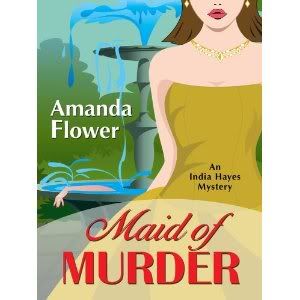
Maid of Murder by Amanda Flower (Book Reviews)

Title: Maid of Murder (An India Hayes Mystery)

Author: Amanda Flower

Publisher: Five Star


Synopsis (from back cover): India Hayes is a lot of things. . . starving artist who pays the rent as a college librarian, daughter of liberal activists, sister of an emotional mathematician, tenant of a landlady who has kissed the Blarney Stone one too many times, and a bridesmaid six times over. But she's about to step into the most challenging role of her life: amateur sleuth.


Childhood friend and now knockout beauty, Olivia Blocken is back in town to wed her bodybuilder fiance with India a reluctant attendant. . . not just because the bridesmaid's dress is a hideous mess, but because she's betraying her brother. Mark still carries a torch for the bride who once broke his heart and sent his life into a tailspin.


When Olivia turns up dead in the Martin College fountain and the evidence points to Mark, India must unmask the real culprit while juggling a furious and grieving Mother of the Bride, an annoyingly beautiful Maid of Honor, a set of hippie-generation parents, the police detective who once dated her sister and is showing a marked liking for her, and a provost itching to fire someone, anyone -- maybe even a smart-mouthed librarian.


India's investigation leads her on a journey through childhood memories that she'd much rather have left in the schoolyard, but to avoid becoming the next victim, it is a path she must follow.


Maid of Murder is a fast-paced, laugh-out-loud mystery set in an amusing world of academia. Readers will fall in love with India Hayes' fierce loyalty and wit.


My thoughts:  I thought this debut novel was a lot of fun.  I love that the amateur sleuth is a librarian.  I worked in a library in high school and would love to be a librarian.  There is just something trustworthy and loyal about someone who loves books.  Anyway - India's family,  inspite of all their eccentricities, really care for each other and and India really goes all out to prove that Mark is innocent. But don't think just because it is a cozy mystery that you will figure it out quickly.  It kept me guessing. I look forward to reading more India Hayes mysteries!


About the author: Author Amanda Flower, a native of Akron Ohio, started her writing career in elementary school when she read a story she wrote to her sixth grade class and had the class in stitches with her description of being stuck on the top of a Ferris wheel. She knew at that moment she’d found her calling of making people laugh with her words. Like her main character India Hayes, Amanda is an academic librarian for a small college near Cleveland. When she is not at the library or writing her next mystery, she is an avid traveler who has been to seventeen countries, forty-eight U.S. states, and counting. Maid of Murder is her debut novel and the first in a series featuring amateur sleuth India Hayes. Amanda is also currently seeking a publisher for her middle-grade children’s mystery, The Mystery of the First Andora. She lives and writes near Akron.


You can find Amanda at her website, Amanda Flower, or on Facebook.


~I received a complimentary copy of this book in exchange for my review.~


Publisher/Publication Date: Five Star, June 16, 2010

ISBN: 978-1-59414-864-4

282 pages


Source: http://booksandneedlepoint.blogspot.com/2010/08/maid-of-murder-by-amanda-flower-book.html

»»  read more

Monday, August 16, 2010

Book Review: The Elegance of the Hedgehog

The Elegance of the HedgehogThe Elegance of the Hedgehog by Muriel Barbery


My rating: 3 of 5 stars


When I was in third grade, I decided that I wanted to be called "Rene" instead of Marie. We had a copy of the Renoir painting, "Girl with a Watering Can" in our living room, and my dad used to call the girl Rene. I wanted to be that girl. Add to that the fact that my third-grade teacher allowed us to adopt any name we wanted, and he would honor that. Great fun for a third grader, so I was "Rene." I cannot recall reading any other books with a "Renee" or "Rene" as a main character, so Barbery attracted me in the beginning.


As soon as I finished this book, I raced to Goodreads to jot down quotes that I liked--beautiful combinations of words that moved me, like these:


--"If you have but one friend, make sure you choose her well."


--"Moments like this act as magical interludes, placing our hearts at the edge of our souls: fleetingly, yet intensely, a fragment of eternity has come to enrich time...When tea becomes ritual, it takes its place at the heart of our ability to see greatness in small things."


--"This pause in time, within time ... When did I first experience the exquisite sense of surrender that is only possible with another person? The peace of mind one experiences on one's own, one's certainty of self in the serenity of solitude, are nothing in comparison to the release and openness and fluency one shares with another, in close companionship ..."


--"In the end, I wonder if the true movement of the world might not be a voice raised in song."


And I also complained to Mike (who finished this book a few weeks ago) that I did NOT like the ending. He responded that he knew I wouldn't like it.


What to say about a book that makes me appreciate words, art, and sliding Japanese doors in a way I've never done before? It makes me want to slow down and focus on the beauty of the world. But the same book also caused me to skim over passages of the protagonists' philosophies about art and other topics.


About a quarter into the book, I realized that I was reading this book with American sensibilities, so I asked Mike about this. I couldn't understand why Renee felt that she could not reveal her intelligence and personality to the rich people in the apartment house she managed. The American in me had a very hard time understanding this (as have many other reviewers, it seems). He explained that when he was in his British boarding school, the boys treated the house cleaners (Yorkshire lasses) in the very same way, as if they were invisible, and if any one of them had showed any sign of intelligence, they would have been perceived as "putting on airs." That helped me understand this novel a bit more.


One of the Goodreads reviewers mentioned the "fetishizing of Japanese culture." Really? Just because Japanese art and customs are admired in this novel, it means they are being "fetishized"??? (which is not a word!) Other reviewers felt that Paloma and Renee were total snobs, looking down on everyone else while feeling that they were outsiders. This is partly true, but I have to admit I enjoyed some of the snobbery about language and grammar. And how dare someone who is rich and privileged not know how to speak in proper sentences??? There simply is no excuse for that, as Paloma or Renee would say.


So, in summary, I could have skipped the long philosophical passages (I enjoyed philosophy in college, but I am done with that!). The book began to get much more interesting once Kakuro appeared and Paloma and Renee met. I enjoyed the burgeoning friendships between unlikely characters; the appreciation of Japanese art and culture; the interesting female characters (Renee and Paloma); and the subtext about snobbery and the class system. But the ending! Meh!!


View all my reviews >>


Source: http://marie-everydaymiracle.blogspot.com/2010/08/book-review-elegance-of-hedgehog.html

»»  read more

Book Reviews: Comparisons and Contrasts

depiction of the Queen of PuntImage via Wikipedia

Summarized herein in the form of an essay is a review of two books written by two distinguished authors of European origin. The books, Eternal Egypt: the Civilization of Egypt from Earliest Times to Conquest by Alexander the Great by Frenchman Pierre Montet translated from the original French by Doreen Weightman and Africa: a Biography of the Continent by Anglo-Saxon, John Reader.


In his book, Africa: A Biography of the Continent, John Reader, eulogizes the prevalence of domesticated plants and animals, technological innovation, the establishment of villages and increasing level of social interdependence in the now empty and waterless Sahara desert even before the pyramids were built (Reader, p. 151). On the other hand, he articulately and meritoriously adduces evidences regarding the cultivation of food-crops such as wheat, barley, peas, and lentils along the Nile River despite these crops being cultivated earlier some 9,000 years ago in the “fertile crescent” of the Near East in reference to “the land between the two rivers”, formerly in the ancient nation of Mesopotamia and currently in the modern state of Iraq. Thus, cultivation of indigenous African plants did not begin in Egypt but rather in the south, an indication of the ancient nation of Nubia. Nubia, a vast land straddling the Nile valley to the south of Egypt was once a colony of Egypt. Both authors unanimously confirm the colonization of Nubia by Egypt. Pierre Montet further explicates how Nubians had their own form of arts and crafts and at the same time borrowed Egyptian artistic traditions (Montet, p. 118).


Rich in natural resources, Nubia was, for over 1,000 years, a major supplier of gold, ivory, timber, animal products, and slaves to Egypt until the emergence of powerful Nubian rulers who instituted a centralized authority that would have severe repercussions on the dwindling pharaonic empires. The arrival of powerful invading Assyrian armies wielding weapons of iron eventually led to the collapse of the once powerful Cushitic kingdom in Nubia. Both authors acknowledge the majesty of the civilization that thrived in Meroe. “Yet the Kingdom of Meroe can be given credit for having carried Egyptian civilization further south than the pharaohs themselves had ever succeeded in doing”, says so Pierre Montet while John Reader concludes its downfall accordingly: “Meroe was effectively an expression of Egyptian civilization rooted in what the pharaohs had called the land of punt-indigenous black Africa.”


The absence of genuine documentation, as Montet claims, is convincing evidence that Egyptians did not reach the confluence of the two Niles. Perhaps, by the two Niles, the author is referring to the two tributaries the Blue Nile originating at Lake Tana in Ethiopia and the White Nile which originates in Lake Victoria and is at the confluence of the Bahr al-Ghazal and Bahr al-Jabel Rivers.


At least the two authors agree on the name “punt” to which they separately refer to as “the land of the God” (Montet, p. 120) and “God’s land” (Reader, p. 196). On the other hand, the authors fail to agree on the exact location of punt in our modern world map. Pierre Montet suggestively assumes the location of punt to have been in the Bay of Hafun figuratively pointing it to the south of Cape Guardafui. In a nutshell, he is of the view that the incense-bearing tree Queen Hatshepsut sought after to exploit is plentifully found in Africa and Arabia Felix respectively.
Pierre Montet, despite employing persuasive historical and scientific research methodologies gained from his many years of distinguished career as an Egyptologist and his accumulated experience during work at the German Archaeological Institute of Berlin, fails to garner convincing consensus to uncovering the validity of the Land of Punt. He implausibly postulates two unrelated localities and as a final point fails to make amends with the reader. In their pursuit of literary reputation, no wonder, many writers tend to huggermugger. On the contrary, John Reader, relying on available evidence, easily recapitulates without making mangled assumptions by placing the location of punt “between the Red Sea and the southern Kordofan province of the Sudan”. Several African tribes and states lay claim to the historical Cush kingdom.


Most notably, Somalis, Amhara, Tigre, Nubians, Oromo, and Sudanese-Arabs place profound hereditary and historical inclination to the Cushitic kingdom of old. Currently, in the modern state of Somalia, there is a region known as Puntland located on the eastern corner of Somalia bordering the Red Sea and closest the Gulf of Aden where frankincense and myrrh -the two most prominent products sought after by ancient Egyptian pharaohs abundantly grow in the wild to this day.


Whichever claim is true; our reliance on historical inscriptions found in the tombs and pyramids of Nubia and Egypt and information gathered from archeological excavations should be enough to serve as concrete and compelling evidence for the moment simply for educational purposes until novel exposures reveal otherwise in the future.


What amuses the skeptical reader is the paragraph in John Reader’s book that state, “the concept of the Nile as a corridor through which the civilizing influence were conveyed to sub-Saharan Africa is the basis of an essentially Eurocentric interpretation of African history, implying that Africans were incapable of developing their own versions of civilization. It has an appealing simplicity, but is contradicted by the evidence.” (Reader, p.195). In one way one or the other, the author himself seems not to the point as regards whether Africans were civilized or not. The judge who could arbitrate on the flimsy and much-debated issue of who-was-who in African civilization is the infant and tender baby archeology whose distinct brushes and micro-blades have failed to go beyond the borders of America, North Africa, and Europe. John Reader reports that, according to the high official Henu, the expedition was undertaken on behalf of Montuhotep III c.1975 BC. On the other hand, Pierre Montet states that the ships were built in Chaldea and that they “sailed down the Euphrates to the Persian Gulf, went round the enormous Arabian Peninsula and eventually reached the land of Punt.” Reader tries to make a case in point by claiming the ship was carried piece by piece across 150 km of desert to the Red Sea coast. (Reader p. 196)
Cited Sources
Pierre Montet, Eternal Egypt: The Civilization of Egypt from Earliest Times to Conquest by Alexander the Great, 5 Upper Saint Martin’s Lane, London WC2H 9EA
John Reader, Africa: A Biography of the Continent, Alfred A. Knopf, New York 1998
Ibid. (Montet, p. 118)
Ibid. (Reader 197)
Ibid. (Montet, p. 120)
Ibid (Reader p. 199)
Ibid (Reader, p. 196)
Ibid (Reader p. 195)
Ibid (Monetet p. 124)


Enhanced by Zemanta


Source: http://cleanthehorn.blogspot.com/2010/08/book-reviews-comparisons-and-contrasts.html

»»  read more